General
info
Lessons & recipes for sev.
techniques
.....single-color
.....logs & canes
.....layered
sheets (orig. tech.)
Stamping, Molding, Onlay
+ Creating lines, texture, or images (stamps, carving, molds, sculpting,etc.)
Antiquing ...& finishing
....other
ways to stain-finish
Inlays ... chips,
wire, etc.
Misc. & other effects
Bone,
horn, teeth, etc.
More websites
with examples of all types of ivory & bone
Faux IVORY
General info
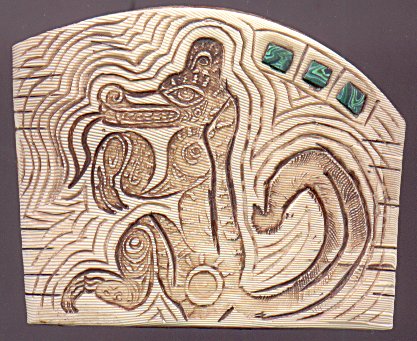
When faux ivory is well done, I don't think an amateur could tell the difference from real ivory... when it's not so well done, it still looks really good!
Techniques
SUMMARY:
Simulated ivory can be made with polymer clay by simply using a plain
ivory-colored clay alone ....but it can look even more realistic
and more organic if created with striations in the final result
because ivory is actually composed of little tubes or half-tubes which are usually
seen from the side when shaped
...the resulting "ivory" is
then textured, stamped, carved, molded or etched... or it is shaped
or "sculpted"
...it may also have "chips" of real
or faux turquoise of other stones, or wire, etc., embedded into it's surface
...after
baking, the dimensional ivory is usually "antiqued" in the low
areas to some degree... then the higher areas are sanded and buffed to
create a surface with a high sheen (not nec. though)
translucent
clays and colored
clays are used for making ivory:
...any brand
of clay can be used (for the translucent and for the opaque cream color.....(or
any cream color can be mixed if it doesn't come the exact shade you want
right out of the package)
..but, translucent clays of different brands
do have a bit of tint in them, which shows up more after baking
.......for
example, Sculpey III's translucent is kind of pinkish after baking, which
makes a different-looking "ivory" ... see example below in Layered
(...it might work to add a bit of yellow or yellow-green to the Sculpey III translucent
to counter that though?)
.......most people prefer a yellowish or a
clearer translucent though, such as FimoClassic or Premo, or Kato
People
often ask me which recipe (& colors) they should
use to make faux ivory/bone. It takes a lot of effort to convince them that ivory
comes in a wide range of colors, from stark white to dark brown, so there
is no need for a specific recipe .
.........and as long as the finished item
presents some level of striation, people usually think they're
seeing some kind of natural calcium material, be it a tooth, tusk or limb. Desiree
(though a solid cream color can also be used... if it's also antiqued, it will
usually fool the eye too)
The
rubbery feel
of Kato clay does not enhance the look either (for me, Sculpey has the right final
"hard" feel, but in raw form is too soft for me to work with). Jacki
....I
just do not like the sheen
on the Kato clay for faux natural things such as ivory and bone.
Jacki
...... I agree
that Kato Polyclay's
finish isn't as natural looking for faux items, although sanding it and
then using 0000 steel wool helps a lot. Dotty
Lines and shapes:
...can be cut into the baked ivory
with pins, cutters, carving tools
...or raw ivory can be impressed
with stamps, molds or other tools (see below in Creating
Lines, Texture, Images., + Sarajane's link at top of page).
I
felt that Emi's ivory slab boxes (shown on Carol Duvall) used up too much of
the precious ivory slab she made
...so to make my ivory go farther,
I just cut thin slices from the ivory stack then lay them onto a base
sheet of ecru or transparent clay... then I make my boxes from that.
Heather
( MORE EXAMPLES of ALL TYPES of IVORY and BONE are below in More Websites )
Ivory
can be simulated in several ways (these are listed from simplest to more complex):
...single-color
of "ivory" or cream-colored clay ...often there will be some translucent
mixed into the opaque ivory-colored clay as well to give a bit of naturalness
and depth
...several colors of clay creating striations (of alternating
translucent and opaque parts):
.........using twisted ropes,
or clay gun extrusions, or bullseye canes, etc.
.........(the
traditional way) using layers of sheets in a stack
.....for striations,
the resulting stacks or canes are usually cut lengthwise into thick
slabs which are placed tightly side by side
single-color
Simulated ivory can be made by simply using a plain ivory-colored clay (the shaped, carved or stamped, etc) and antiqued
Sarajane's
barrettes (these are also simulations of "carved".ivory
which have been stamped or/textured)
http://polyclay.com/impressed.htm
( Group #6 )
http://www.polyclay.com/beads.htm
and
http://www.polyclay.com/hands.htm
also
http://flickr.com/photos/sarajanehelm/2959389562
Jenny
Dowde's many examples
http://www4.tpgi.com.au/users/jdesigns/Simulations.jpg
(see
more below and in Websites)
logs and canes
twisted ropes... (I make ivory using the same method that I also
use for striped cloth and wood.)
--twist together and
compress rods of ivory colored clay (a one-to-one blend of
Ecru and White work well) and translucent.
--Run through the pasta
machine so the stripes are perpendicular to the rollers to produce a striped
sheet of ivory. (The more compressed and twisted the original rod, the more finely
grained the ivory.) I believe Donna Kato uses the same technique. Katherine Dewey
Make
a cane composed of many thin clay gun extrusions
of translucent and off white (an occasional darker off white is
ok)
--reduce the cane by greater than 50%.
????
--cut it into quarters
and lay them side by side again ... press together
--now wrap this
(cane with?) into a thin layer of translucent-white mixture,
and then wrap with a layer of plain translucent (these represent the enamel
layers).
(see Faux Turquoise&Wood
> Wood, for other hints on making striated effects with ropes-extrusions,
etc... just use ivory-type colors instead of wood colors)
Desiree's
lesson on creating ivory with 2 bullseye canes (wrapped logs), laid
out checkerboard fashion for the final cane, which she then shapes into
an ivory horn pendant (based on Tory Hughes class)
......first
bullseye cane is champagne+white clay mix wrapped around a translucent
log
......second bullseye cane is the reverse... translucent clay
wrapped around champagne+white log
(...Desiree also covers antiquing
and carving (and inlay?) and buffing in this lesson)
http://desiredcreations.com/howTo_CAivoryHorn.htm
(...teapotdkny
uses this method for her flat ivory pendants, but rolls out a length
of the final cane rather than shaping it into a 3-D item)
to
use this type of ivory cane
..... for a flat piece of
ivory....roll out or press the ivory cane as thin as you want it
(...or can also layer a thin large "slice" of it onto a base sheet of
translucent to use up less of the cane)
....
for a 3-D item (like Desiree's horn ...reduce the cane to a slightly
smaller diameter than you need ...cut off a section about 2/3's the length you
are wanting ...shape carefully (for horn, reduce one end into a long tooth
shape).
(see more on horns and bone just above)
The root area of ivory (where it was cut off) --and some kinds of bone-- can also be simulated by using the end (or cross-section) of any of these final canes or stacks (rather than using their outer sides)
layered (stacks) --the original .technique
basic
lesson:
....make a sheet of translucent clay (see above
for diff's between brands)
.........and a sheet of a light cream-colored
clay (using equal amounts of white and ecru clays, or an equivalent)
..... (sheets are usually created with a pasta machine --which is quicker and
more even, though can be done by hand)
...the sheets are then stacked alternately
...the
stack is rolled thinner ...then the long stack is cut in half crosswise
and the two halves are restacked on each other.
.........(the rolling/cutting/stacking
is repeated until the lines are very thin ...personal choice
for how thin)
...finally, thick slices-slabs are cut from the *side*
of the stack (the side with the stripes showing)
......the slices
are laid on a surface side by side, striations showing ...and pressed
together to make a thick sheet
This final sheet of "ivory"
can then be cut to any shape desired, or stamped on, etc.
some
close-up examples
...Dayle's faux ivory (flat piece + horn... wide irregular
striations)... top one mine
backs http://pg.photos.yahoo.com/ph/dianeatglassattic/detail?.dir=645a&.dnm=1f00.jpg&.src=ph
fronts...
stamped, some areas colored (maybe oil paint before baking?), some pin-cut, some
w/ inlays...all antiqued
http://pg.photos.yahoo.com/ph/dianeatglassattic/detail?.dir=645a&.dnm=3c19.jpg&.src=ph
...my
photos show a finished
sheet of ivory... created with 7? laid-together strips, cut from the
side of a long stack
......original stack is on the right (top layer
is white, all layers somewhat visible on left side)
......other misc. pieces
of faux ivory (2 top row, one small square) are made from Sculpey
III's translucent, which is pinker
and less convincing)
http://pg.photos.yahoo.com/ph/dianeatglassattic/detail?.dir=645a&.dnm=f634.jpg&.src=ph
Desiree's
lesson on making faux ivory
... she also shows how to add inlays
and impressed lines/shapes... and antiquing and buffing it
(to make a pendant)
http://desiredcreations.com/howTo_CAivoryPendant.htm
later
ivory pendants of Desiree's. . . many with inlays, wire
and brass escutcheon pins, and captured beads, etc.
http://desiredcreations.com/gallery2necklacesPg1.htm
Elizabeth's
lessons on making faux ivory with Premo's translucent,
white and ecru, and inlaying other fauxs into it for a pendant
http://thepolyparrot.com/faux_looks.pdf
(requires Acrobat Reader)
Here
is a simple lesson:
--Condition a quantity of translucent clay and press it into a flat sheet
--Use the same amount of ivory-colored clay,to make a second sheet the
same size. Sculpey makes an ivory, or you can use a mix of half white and half
champagne Fimo, or whatever mix you like for an ivory color.
--Lay one sheet
on top of the other and cut in fourths.
--Stack the fourth-sheets.
You now have a block with alternating layers of ivory and translucent, a total
of eight layers.
--Press and flatten the block with your hands, then cut it
in fourths again and stack again; you now have 32 layers. Repeat this twice
more.
......You end up with a block of finely layered clay.
....You probably
won't be able to see the layers very well - the translucent will
become clearer during firing and they'll become more obvious. Jeanne R.
(see
Jean's examples below in Websites
.........and see this
page if she gets around to a visual lesson: http://www.jaedworks.com/clayspot/index.html
)
Emi's
lesson (pictures are better
here than in her second lesson below) on making ivory with a stack
....(her basic stack has 3 colors (making 4 layers)
of very thin FimoSoft clay in this order: white, translucent, beige-Sahara,
translucent (alternating the translucent with the white, then the beige)
...she
then creates a large bead (impressed on both sides) by cutting a (long)
slice from the ivory stack, wrapping it around most of a core of black
clay log (short ends of ivory will butt), then placing the bead between two
stamps and pressing down... after baking, she antiques the depresions
....the
photo of her "alternative design" also shows an example of inlaid
cane slices (face slices, etc.)
http://www.hgtv.com/hgtv/cr_clay/article/0,1789,HGTV_3236_2251543,00.html
Emi's
2nd faux ivory lesson (on Carol Duvall) with 3 colors
(making 3 layers) white Fimo, beige Fimo, translucent
...plus
her lesson on making a box (on feet, with lid with slabs
of the ivory)... slabs also stamped with thick stamp and onlys added
......baked,
antiqued
http://www.hgtv.com/hgtv/dc_faux_other/article/0,1793,HGTV_3401_1370888,00.html
Donna
Kato's lesson on making faux ivory (very even, visible striations)...
pushing into a mold, baking, then antiquing
http://www.firemountaingems.com/beading_howtos/beading_projects.asp?docid=63EB
Victoria
J's 3-D ivory leaves, on ivory background... back side stamped/textured...antiqued
....the
oak-shape leaves appear to be a sheet of faux ivory pressed with a real
leaf or in a mold, then draped over a pad of clay to
create a bas relief onlay.. back side of pendant is impressed with texture
sheet... after baking, all areas were antiqued (with burnt umber?)
in the depressions
http://www.polymerclaycentral.com/chall_oct04.html
(to see back side, click on the 2nd "Detail" button)
worthart's
lesson
on ivory and bone
using Sculpey clays (translucent, ivory.... translucent,
ivory...etc.).
........ (but she prefers the FimoClassic white
and ecru mixed, plus a layer of Premo translucent )
....after making
her ivory stack, she makes a horn by covering a core of clay
with large slices of ivory (some slices were too thin... could see color of core
underneath)
...she "distresses" after baking... also using
Kiwi brown shoe polish (for finish?) after the brown paint
http://www.picturetrail.com/gallery/view?p=999&gid=582586&uid=448958
For her ivory, Sara Jane uses 1 part white... 1 part translucent
... small amount golden yellow ...small amount brown-caramel
----the
brown and yellow amounts can vary widely, as can real ivory
....sometimes I
go very heavy on the yellow for an aged ivory or bone look,
or to simulate old Bakelite which was the precurser to our polymer clays...it
was a phenol based acrylic, flammable, and ages to a golden tone, and is highly
prized by collectors now
. . .translucent is a must for the illusion of bone
(and other natural materials), and gives a depth and shine, especially when buffed.
Sara Jane
Klew’s
long striated- ivory beads with cane-slice onlays
http://www.klewexpressions.com/drum_beads.htm
Luann’s
faux ivory horses use layers which aren't straight... have been
curved or enlarged on parts of horse bodies
http://www.luannudell.com/jewelry.html
Linda's
head has pieces which were cut at an angle across the grain of faux ivory
(shaped pieces for "sculpted" head)
http://tanstaafl512.tripod.com/images/LindaFranzelClaussen.jpg
(see many types & degrees of striation in this swap: http://tanstaafl512.tripod.com/scrimshawswap.html )
Most people use a pasta machine to create the layers (and a brayer to thin the stacks), but Jeanne R. feels that "using your hands will make the thickness a little irregular, which is desirable"...
Stamping, Molding, Onlay + Creating Lines, Texture
or Images
stamping:
Another method for simulating carving on the faux ivory (& scrimshaw) is to
use a rubberstamp with raw clay. The stamp can be:
----pressed to a
pigment ink pad (any color or gold/metallics), then pressed into the raw
clay and baked (brown ink can look very realistic on ivory!!);
----or the
bare stamp can be pressed into raw clay, baked, then antiqued (its
depressions rubbed full of dark paint) or backfilled with soft clay of
another color, then wet-sanded to remove excess from surface.
...Tonja's various
stamped and antiqued faux ivory ... (+ cylindrical beads with
gouged areas?) (thick striations)
http://www.tonjastreasures.com/jewelry2/tn7.htm
.....http://www.tonjastreasures.com/jewelry2/tn40.htm
...Grace
Yen's stamped and antiqued kimono image on faux ivory pendant
http://pg.photos.yahoo.com/ph/dianeatglassattic/detail?.dir=645a&.dnm=596c.jpg&.src=ph
...Karen
O's ivory stamped with texture sheet? (also antiqued)
...with lg. turquoise cabochon inset
http://www.polychic.com/images/fauxivoryturqpendant.JPG
...image
on Altoid box made with thick-lined rubberstamp?, then antiqued
with brown paint
http://isisesc.supelec.fr/gallery-nenuphar/Altoid_tins/aam
(gone?)
texturing,
molding, stamping, and/or onlaying
cyn clay's small flat beads with
stamped or molded patterns, or onlays... antiqued
http://www.flickr.com/photos/cynsclay/2509506868
Barbara
Lang's various stamped, molded, and antiqued non-layered faux ivory
http://www.barbaralang.com/PolymerClay/index.html
"carving"
or faux carving may be accomplished before or after baking with
a needle tool, pin, linoleum cutters, or anything else that works.
Violette's
carved faux ivory bowls (after baking, with linoleum cutters)
http://creaplastic.free.fr/10vio_02.htm
Jane
Zhao's scrimshaw scene "painting" on flat clay (thin
lines, before baking, with pin)
http://pg.photos.yahoo.com/ph/dianeatglassattic/detail?.dir=d4aa&.dnm=552e.jpg&.src=ph
Varda's
carved-"drawn" with needletool, etc.(thicker lines, before
baking) ...also stamped
http://tanstaafl512.tripod.com/images/VardaLevRam.jpg
Claude's
carved "faux ivory" head in profile (or sculpted/carved
before baking?)
http://www.chez.com/creabijoux/interieur/GALLERIE/grandes%20photos/203.htm
.....(see
much more on carving and scrimshaw in Carving)
"sculpting"
& shaping can be done before or after baking ...these examples may
be done that way or not (hard to tell)
...Donna's
sculpted rabbit & skull, etc., like ojime
beads... thickly striated layers ... also impressed and antiqued
http://www.picturetrail.com/gallery/view?p=999&gid=958573&uid=448958
(pictures too pink)
...Linda's head made
from shaped pieces of striated ivory
... no antiquing
http://tanstaafl512.tripod.com/images/LindaFranzelClaussen.jpg
small ivory sculpts (unstriated, antiqued)
http://sdpcg.org/Slide%20Bank/pd30.jpg
various unstriated (sculpted, molded, texured) faux ivory, used on small
Bottles of Hope
http://www.amaco.com/index.php?page=bottlesofhope
Carolyn
S's many small (probably) molded items (sculpted first?)...intended to for
altered books, collage, etc.....heads, sealife, etc., many faux
ivory
http://www.picturetrail.com/gallery/view?p=6&uid=969632&
(click on "Embellishments")
Kim Cavender's could-be-faux-ivory cuff,
with many areas of sculpting & texturing
http://www.flickr.com/photos/kimcavender/2569998893
etching...
etched clay created with the "ripped transfer" technique
.... if a photocopy is quickly ripped from raw clay, it will
remove a tiny bit of (faux ivory) clay wherever it's black lines were,
leaving a slightly incised or etched version of the photocopy image in
the clay
... when the piece is antiqued, paint remains in the incised
line... or the lines can be backfilled with softened clay
(for much
more, see Transfers > Etched)
molding
faux ivory creates heavier lines and shapes (upraised and depressed)
.......could
use shallow molds ... or even deeper ones (tho striations may then become irregular)
.....texture
sheets can also be used, which will create a molded or stamped look
....final
result can also be antiqued
Julie
B's molded, antiqued faux ivory
http://www.azpcg.org/members/julie_blankenship.htm
(click > arrow till
see all photos... click to enlarge
each)
Marty's
molded faux ivory face on pendant (widely striated)
http://hometown.aol.com/Martywoos/index.html
(bottom of page) (gone)
The crevices of dimensional faux ivory (stamped, molded, carved or etched)
is usually "antiqued" to bring out its shapes-lines, and also to simulate
dirt and aging effects acquired on the piece over time
........antiquing
will also accentuate some of the tiny cracks created by the original layering
(if using the layered method)
....can antique only off-white and/or
translucent bits added as onlays too to simulate carved bits, etc.
dark
brown acrylic paint (tube acrylic paints best because thicker)
is usually used, but could use any color
........(Burnt Umber is popular...
Marilyn uses a warm brown by Delta Ceramcoat called Autumn Brown)
....the
paint is rubbed or toothbrushed into all the crevices of
the baked clay, allowed to set a bit, then rubbed or rinsed offof
just the higher parts of the dimensional item --use a dry (or damp?) flat
cloth for removing
... the amount of paint allowed to stay in the crevices
will depend on the length of waiting time, and degree of wiping
the clay
…a bit of bar soap can be used if needed to remove any
film left on the upper parts.
....let dry thoroughly before continuing;
can use oven to expedite. (some people do just one section of the clay at a time.)
....Desiree's
lesson on making ivory includes a section on antiquing
http://desiredcreations.com/howTo_CAivoryHorn.htm
...Desiree says that baking the antiquing paint on for about 10 min.
will help adhere it
..Actually I think the more translucent
stains created by oil paints, etc. are better for lighter colors
like faux ivory (than acrylic paints). Sarajane H.
stamped,
molded, and antiqued non-layered faux ivory pieces, by Barbara Lang
http://www.barbaralang.com/PolymerClay/fauxivorybone.html
After antiquing, the piece will usually be given a sheen by wet-sanding (after paint is completely dry) with 400 and 600 grit sandpaper at least (or 0000 steel wool)... then buffing with a rotating muslin wheel (or even blue jeans).
(see
more on antiquing and staining below in "Other Ways to Stain-Finish")
(see more info on "antiquing" in
Molds
> Antiquing)
Barbara
McGuire's lesson on stamping/ antiquing with gold iridescent
acrylic paint over white clay (like "ivory")
http://hgtv.com/HGTV/project/0,1158,CRHO_project_9826,00.html
Jenny's
lesson on stamping and antiquing (with different colors)
http://www.pcpolyzine.com/february2001/fragments.html
I
always stain my finished pieces with a mixture of Varathane and Pearl-Ex
powders (antique bronze or sunset gold are very nice) with a drop or two of black
acrylic paint added. (dirt colors, to put it bluntly)
...then wipe off
most with an old white tshirt (after a while, the dried stain on the tshirt turns
it into a good buffing cloth--almost like emory cloth!)
This is a good alternative
to the "grained" look you get with the stacked layers, which is very effective
as well...but I like both! Sarajane Helm
If
the clay is light in color, I have used high concentrations of tea (5 tea bags
to 1 cup boiling water...let steep 10 minutes so tannin comes out) to stain my
ivory
...then I just lay a paper towel gently over the clay and it absorbs
the tea... no rubbing.
I have used Kiwi (wax?) shoe polish to "age" faux ivory and faux wood clay. It works great, and in conjunction with acrylic paints, provides some real nice depth..... the polish really buffs up nice (and I have had no problem with the color coming off). Tracy
Before
baking the faux ivory clay, some people add pre-baked, colored
polymer clay tiles/chips of different shapes which are pressed into
the unbaked "ivory".
(see Mosaics
& Inlay for more on making those kinds of chips and bits)
....Other
inalys can be used as well, such as cane slices or small (real)
stone chips (which can be bought in places where beads are sold
,even at Michaels? --many of those seem to be brown or turquoise colored)
Helen
Ps' chip inlays
.http://www.picturetrail.com/gallery/view?p=999&gid=4530485&uid=531344
Desiree's
lesson on impressing inlays into faux ivory
http://desiredcreations.com/howTo_CAivoryHorn.htm
Suzanne's
faux? turquoise (& faux wood) embedded in faux ivory lid (black
framing for each?)
http://www.picturetrail.com/gallery/view?p=999&gid=286292&uid=149408
Tory Hughes’ carved ivory inlays of orange
and blue triangle shapes
http://www.gameplanvideo.com/videos.htm
(Vol.9)
Varda's
square faux malachite inlays (piece also stamped, and raw-carved/impressed)
http://tanstaafl512.tripod.com/images/VardaLevRam.jpg
Dayle's inlaid cut-up cane slices?, inlaid on faux ivory minibook
pendant... & other inlays
http://www.dayledoroshow.com/images/07.jpg
http://dayledoroshow.com/pics3.htm
Emi's
example of inlaid cane slices and face, etc....(+ lesson
on faux ivory)
http://www.hgtv.com/hgtv/cr_clay/article/0,1789,HGTV_3236_2251543,00.html
Helen P's inlaid chips of faux turquoise, coral,
etc., pressed into faux ivory pieces
http://www.picturetrail.com/gallery/view?p=999&gid=4530485&uid=531344
Julie
B's turquoise chips embedded in molded ivory
http://www.azpcg.org/members/julie_blankenship.htm
(click > arrow till see all
photos... click to enlarge each)
Other
things can be embedded into faux ivory too wire, brass escutcheon
pins, beads and captured beads, etc.
http://desiredcreations.com/gallery2necklacesPg1.htm
Karen O's large turquoise cabachon set into ivory... she also
embeds some metal beads
http://www.polychic.com/gallery.html
(....see more in Websites below?)
Miscellaneous... other effects
I
was playing with Bunny's fake ivory recipe, and ended up using layers of FIMO
Art Translucent, Premo translucent, FIMO White, Sculpey Ivory and FIMOSoft Beige
..Different
thicknesses, stacked, cut, restacked, then marbled pretty well. It looks like
a block of a solid eggshell color.
....However, if you
bake it for 8-12 hours, it does wierd stuff (mostly the Sculpey??).
.......16 hours gave me "ebony," believe it or not.
.......but
less time gave me really interesting color combinations --- all in the same
piece! ... amber, a purplish color and very dark brown
(all from that off-white mixture, baked at the right temp, but for too many hours.
Strange.)
... I'm going to carve and backfill a few of thes... it would be
neat to combine with petroglyphs. Elizabeth
This
is a faux something or other :)....the recipe for these was translucent
premo, green/blue pearlex and some gold leaf stuff. Sera
...I
think first of old ivory or perhaps a jade? Catherien
...like the onyx
on an antique clock that we have. ol' rebbie
For
other canes and sheets of pattern made with a technique similar
to this (i.e., cutting thin strips, rotating them 90 degrees, then recombining,
see :
Canes--Gen.
Info for making sheets from cane slices
Canes--Instructions
for making Reduced
Damascus Ladder and Ikat
some kinds of bone (as well as the root area of ivory --where it was cut off) can also be simulated by using the end (or cross-section) of any of the final canes or stacks above for making faux ivory (rather than using their outer sides)...see above in Logs & Canes and in Layered
worthart's
lesson on bone
and/or ivory
...she uses stack of Sculpey III translucent and
Ivory Brilliant layers (but
prefers the FimoClassic white and ecru mixed, plus a layer of
Premo translucent )
....after
making her basic stack, she makes a horn by covering a core
of clay with large slices of ivory (some slices were too
thin... could see color of core underneath)
......she "distresses" the surface after baking... also uses
Kiwi brown shoe polish (for finish?) after the brown paint
http://www.picturetrail.com/gallery/view?p=999&gid=582586&uid=448958
Donna
Worth's lesson on skulls and full skeletons
http://www.picturetrail.com/gallery/view?p=999&gid=863030&uid=448958
Desiree's
lesson on making faux ivory, with inlays and impressed
lines/shapes, then antiquing and buffing it (to make a pendant)
http://desiredcreations.com/howTo_CAivoryPendant.htm
Desiree's
lesson on making faux ivory horn, with inlays and
impressed lines/shapes, then antiquing and buffing it
http://desiredcreations.com/howTo_CAivoryHorn.htm
later
ivory pendants of Desiree's. . . many with inlays, wire
and brass escutcheon pins, and captured beads, etc.
http://desiredcreations.com/gallery2necklacesPg1.htm
Johnny's
faux horn, etc., many with tiny eschutcheon-type nails, stamping/carving,
etc.
http://www.pcpolyzine.com/0306june/kuborssy.html
Wendy
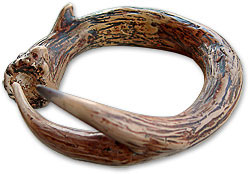
M's cuff of forked faux antler, with heavy texturing and antiquing, at
polymerclaydaily
http://polymerclaydaily.com/wp-content/uploads/malinowantler_lg.jpg
Shelley
Attwood's faux dark, bone/ivory/wood rock pendant with carving
http://www.npcg.org/houston/memberpages/shelleyatwood.htm
Luann’s
darker antler tip, with impressions
http://www.luannudell.com/jewelry.html
Tonja's
faux bone-ivory mahjong tile bracelet (other side different)
http://www.tonjastreasures.com/jewelry1/tn20.htm
Kellie's
faux "bamboo"--ivory (website
gone)
faux
bone (for skulls & skeletons)
http://www.majestic-n.com/majestic/skelprod.html
(gone?)
Denise in Austin's faux bone mask,
with lots of texturing/pitting and antiquing with black
http://hobbystage.net/art/denise_in_austin/
(near bottom)
(gone?)
....(see
also Tory Hughes' video on creating faux bone and ivory
in Websites below)
Jody's
demon's yucky teeth ..could be bone too
http://www.pbase.com/image/175471
....(for
more on teeth of all kinds, see Sculpting-Body
> Teeth .... and maybe Halloween
for more nasty teeth)
(for
more examples and lessons on making bone on this page, do
a Ctrl + f search for the word bone )
(for faux scrimshaw, and other things that can look like bone or ivory, see also Carving)
(for
skulls, skeletons, see
also Halloween
> Skulls & Skeletons and Dia de los Meurtos)
More
WEBSITES for all ivories & bone
Tory Hughes’ ivory, carved and some inlaid, (see Vol. 9).. and video
on creating ivory and bone
http://www.gameplanvideo.com/videos.htm
various
looks of faux ivory (created by diff. people)... stamped or carved
into
http://tanstaafl512.tripod.com/scrimshawswap.html
Cindy's
woven vessel (strips of faux ivory woven around
temp.armature... later antiqued)... also top
http://www.cindysartandsoul.com/images/gallery/cyl4.JPG
Jeanne’s faux ivory & turquoise
(some chips, some impressed, etc.)
http://www.jaedworks.com/gallery/southwest/index.html
(click on each for many more)
Luann’s
carved faux ivory fish and horses ... and also antler
tip
http://www.luannudell.com/jewelry.html
Paulo's
faux ivory heishi spacer beads and long beads
http://pg.photos.yahoo.com/ph/dianeatglassattic/detail?.dir=645a&.dnm=33c6.jpg&.src=ph
Jenny
Dowde's faux ivory and bone (plus other fauxs)
http://users.tpg.com.au/users/jdesigns/ClayGallery.htm
Celie Fago's polymer handles for tools
http://www.tinapple.com/oldsite/cynthia/retreat/index.htm
Dayle’s various faux ivory pieces
http://www.dayledoroshow.com/pics1.htm
(and backgrounds??)
http://www.luckysquirrel.com/ag_ddoroshow.html
http://www.societyforcalligraphy.com/workshops/doroshow/pages/1010111x_JPG.htm
(also 20x)
http://www.societyforcalligraphy.com/workshops/doroshow/pages/P1010011_JPG.htm
(also 45)
Irene
D. uses many fauxs as tiles --stamped/carved/distressed
ivory tiles (& box lids?)
http://www.good-night-irene.com/tiledclocks/tclocks.html
(look under Older Work)
Christine
Brasher's ivory? ---not antiqued
http://www.polymerclaycentral.com/pcc/featured/brasher.html
(White
On White)
Karen
O's tube beads with stamping or transfers over faux ivory
http://www.polychic.com/images/ivorytransfertubebead.JPG
http://www.polychic.com/images/fauxivorytransferbead.JPG
Klew’s
long ivory beads with cane-slice onlays (striated)
http://www.klewexpressions.com/drum_beads.htm
Xtine's
faux ivory frame for pendant... with leafy-flowery onlays,
around cane slice of zebra
http://creaplastic.free.fr/14_06.htm
Debbie
Jackson's faux ivory ethnic faces... features created with ivory onlays
...and antiqued
http://www.tinapple.com/oldsite/cynthia/dolls.html
Gera's faux ivory boxes, stamped/carved then antiqued http://members.shaw.ca/gera/new_page_11.htm
Linda T's faux ivory with carving, impressions,
paint and inlays (plaquing shows up) (website
gone)
(very wide "stripes") (website
gone)
Kat's
round faux ivory boxes, distressed but not striated? or maybe stiff "cracked"
clay?, with onlaid molded medallion or transferred dragon, antiqued
NOW AT? .... http://albums.photo.epson.com/j/AlbumList?u=4153008/boxes.html
Kat's faux ivory with turquoise and coral inlays
NOW AT? ....
http://albums.photo.epson.com/j/AlbumList?u=4153008/jewelry.html
Zkripke’s faux ivory with transfers necklace http://artistathome.com/zkripke
Jenny's "old" ivory (website
gone)
Barbara's sort-of faux ivory? (website
gone)
Greg's
ivory box, with inlaid shapes, carving, stamping/coloring (website
gone)
Barbara's
Nigerian masks (ivory, carved, and embellished) (website
gone)
Ed's
faux ivory and bone miscellany; postage stamp with ivories
http://edsclaypage.homestead.com/Gallery2.html
(gone)
Barbara's
ivory box?